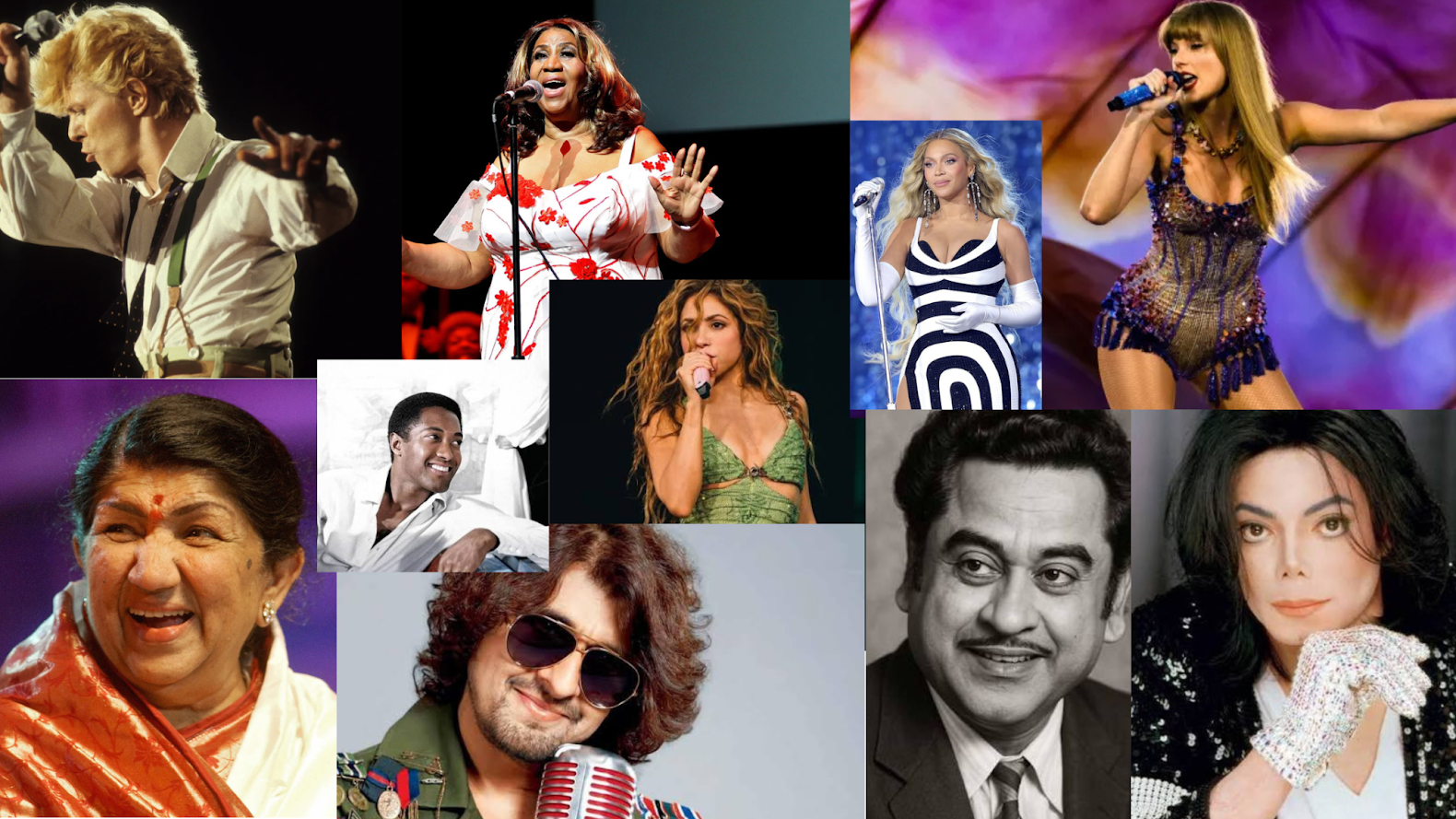

Choosing the best singer in the world is not simply about vocal range, high notes, chart success, or the number of awards an artist has won. Great singing can be powerful, subtle, raw, emotional, unusual, or instantly recognizable. What truly matters is how an artist uses their voice and the lasting impression they leave on music and listeners.
For this list, we looked across generations, countries, languages, and musical genres to create a diverse global selection. Our ranking considers several factors, including vocal ability, originality, emotional expression, influence, versatility, longevity, iconic recordings, cultural impact, and overall musical legacy. We also considered how each singer influenced other artists and whether their work continues to resonate with audiences today.
This is a list of the greatest singers, not simply the greatest voices. Technical perfection can be impressive, but a distinctive or unconventional voice can be equally powerful when it gives an artist a unique identity.
From Aretha Franklin and Whitney Houston to Lata Mangeshkar, Freddie Mercury, Celia Cruz, Mariah Carey, Beyoncé, and Taylor Swift, these artists represent different kinds of greatness. What connects them is their ability to make songs unforgettable and leave a musical legacy that crosses generations.
1. Aretha Franklin
Aretha Franklin’s greatness was rooted in gospel, but she never allowed herself to be confined by it. She could move from tenderness to vocal thunder within a single performance, giving soul music an emotional authority that became almost impossible to imitate. “Respect” became more than a hit; in Franklin’s hands, it became a defining cultural statement.
Her importance also lies in interpretation. She could take a familiar song and make it sound as though it had been written specifically for her. That combination of technique, musicianship and emotional command puts Franklin firmly among the best singers in the world.
2. Whitney Houston
Whitney Houston had the rare ability to make extraordinary technique sound effortless. Her clean tone, control, dynamic range and ability to move from a soft phrase into a full-power climax made her one of the defining vocalists of modern pop and R&B.
What separates Houston from many technically gifted singers is her phrasing. She did not simply demonstrate what her voice could do; she used technique to serve the song. Her influence can still be heard in the vocal approach of countless contemporary singers.
3. Sam Cooke
Sam Cooke helped build the bridge between gospel and mainstream soul. His voice was smoother than many of his contemporaries, but there was still a strong gospel instinct underneath it—the feeling of stretching a phrase until it carried more emotion than the words alone could express.
His career was tragically short, yet his catalogue remains remarkably influential. Cooke’s combination of songwriting, melodic instinct and vocal warmth helped establish a blueprint for modern soul singing.
4. Mariah Carey
Mariah Carey is one of the clearest examples of technical ability becoming an artistic signature. Her extraordinary upper register, whistle notes, agility and melismatic runs became major features of contemporary pop and R&B singing.
But reducing Carey to her range misses the larger achievement. She is also a songwriter and producer who helped shape the sound of mainstream vocal music from the 1990s onward. Many singers who came after her adopted elements of her vocal vocabulary.
5. Ella Fitzgerald
Ella Fitzgerald could make difficult jazz singing sound almost playful. Her pitch, rhythmic precision, improvisation and famously agile scat singing gave her an extraordinary command of melody.
She also possessed something harder to measure: ease. Even when the music demanded considerable technique, Fitzgerald rarely sounded as though she was struggling to execute it. Her recordings remain essential listening for anyone interested in jazz vocals.
6. Freddie Mercury
Freddie Mercury was not simply the voice of Queen. He was one of rock’s great interpreters, capable of moving from theatrical grandeur to vulnerability without losing his identity.
His singing worked because it matched his extraordinary understanding of performance. He knew when to push, when to pull back and when to let a single phrase carry the drama. His voice and stage presence together created one of the most recognisable frontmen in popular music.
7. Stevie Wonder
Stevie Wonder’s place on this list goes beyond his voice. He is a singer, songwriter, keyboardist, composer and arranger whose work helped redefine soul, R&B and pop.
His voice can sound joyful, urgent, vulnerable or playful, but it is always connected to the musical idea surrounding it. Albums such as Songs in the Key of Life demonstrate why his legacy cannot be separated from his extraordinary musicianship.
8. Beyoncé
Beyoncé represents a more complete modern model of vocal artistry. She combines vocal control and agility with interpretation, choreography, production and an unusually detailed understanding of performance.
Her voice can move from restrained R&B phrasing to demanding belts and intricate runs, but technical ability is only part of her appeal. Her willingness to experiment with genre and presentation has helped make her one of the most influential performers of her generation. Her 2025 Grammy win for Cowboy Carter also made her the first Black woman to win Album of the Year since Lauryn Hill in 1999.
9. Lata Mangeshkar
Lata Mangeshkar’s importance cannot be understood simply by counting songs. For generations of Indian cinema, her voice became the voice of the heroine.
She recorded thousands of songs across numerous Indian languages during a career spanning more than six decades. Her ability to maintain a remarkably clear, controlled sound while adapting to different composers, languages and characters made her central to the development of Indian playback singing. She also became an important advocate for singers’ royalty rights later in her career.
That enormous cultural reach makes her one of the strongest candidates whenever the conversation turns to the best singer in the world.
10. Taylor Swift
Taylor Swift’s place in the top 10 reflects a different kind of vocal greatness. She is not primarily known as a powerhouse vocalist, but judging her only by vocal range would miss why she has become one of the defining singer-songwriters of her generation.
Her strength is the connection between voice, lyrics and storytelling. She has moved from country into mainstream pop and then into folk- and alternative-influenced songwriting while continually reshaping her sound. She is also the first and only artist to win the Grammy for Album of the Year four times, for Fearless, 1989, Folklore and Midnights.
That combination of songwriting, interpretation, reinvention and cultural influence makes her inclusion in a modern list of the best singers in the world defensible—even if the criteria are different from those used for Franklin, Houston or Fitzgerald.
11. Mohammed Rafi
Mohammed Rafi deserves serious consideration in any genuinely global list of great singers. His extraordinary versatility allowed him to move between romantic songs, classical compositions, qawwali, devotional music, patriotic songs and comic performances without losing his vocal identity.
His greatest achievement may have been his ability to become the character behind the song. The voice could sound heroic, playful, vulnerable or devotional depending on what the scene demanded. His influence on Indian playback singing remains enormous.
12. Kishore Kumar
Kishore Kumar had something that cannot be taught in a vocal academy: personality. His voice could sound romantic one moment and mischievous the next, and his yodelling and playful vocal techniques became part of his unmistakable identity.
He was also an actor, composer and filmmaker, but his playback singing remains central to his legacy. His ability to communicate personality through a melody made him one of India’s most enduring popular voices.
13. Asha Bhosle
Asha Bhosle’s career is a lesson in versatility. She did not remain associated with one particular vocal image; instead, she explored film songs, ghazals, pop, classical-influenced music, folk and other styles.
That adaptability is one reason she belongs in a global discussion of the best singers in the world. Her career lasted for more than eight decades, and her recorded output crossed multiple Indian languages and musical styles. She left behind one of the most extensive recording legacies in Indian music.
14. Marvin Gaye
Marvin Gaye could make soul music sound intimate without losing its social weight. His romantic recordings established one side of his artistry, while What’s Going On revealed a singer willing to confront war, poverty and social unrest.
His importance lies partly in that transformation. Gaye showed that a commercially successful soul singer could use his voice to ask uncomfortable questions about the world around him.
15. Billie Holiday
Billie Holiday’s greatness was never about vocal acrobatics. Her power came from phrasing, timing and emotional interpretation.
She could bend a melody, delay a word or alter a line just enough to change its emotional meaning. Her approach permanently influenced jazz and popular singing and remains a reminder that the best singer in the world does not necessarily need the biggest voice.
16. Ray Charles
Ray Charles helped create the sound of modern soul by bringing gospel, blues, jazz, country and R&B into the same musical space. His voice could shift from gritty and forceful to warm and conversational, while his piano playing gave his performances another layer of character.
His importance goes beyond his vocal ability. Charles showed that musical boundaries could be crossed without losing authenticity, influencing generations of soul, R&B and country artists.
17. Michael Jackson
Michael Jackson developed a vocal style that was as distinctive as his dancing. His rhythmic phrasing, breathy textures, sharp vocal attacks and expressive ad-libs became important parts of his sound.
From Off the Wall and Thriller to Bad and beyond, Jackson demonstrated an unusual understanding of how voice, rhythm, production and performance could work together. His influence on global pop music remains enormous, making him an essential name among the best singers in the world.
18. Celine Dion
Celine Dion built her reputation around control, projection and an ability to sustain demanding melodies without losing emotional clarity. Her voice became particularly associated with the grand power-ballad tradition of the 1990s.
Yet her career has covered much more than dramatic ballads. She has recorded in multiple languages and performed across pop, adult contemporary and French-language music. Her combination of vocal discipline and international reach gives her a strong place on this list.
19. Frank Sinatra
Frank Sinatra changed the expectations of what a popular male singer could do with a song. His greatest weapon was not sheer vocal volume but phrasing. He understood how to pause, stretch a word or slightly alter a melody to make lyrics feel personal.
His work with arrangers such as Nelson Riddle and his celebrated recordings of the Great American Songbook helped establish a standard for sophisticated popular singing that continues to influence vocalists today.
20. Elvis Presley
Elvis Presley brought together country, blues, gospel and rhythm and blues influences to create a vocal style that suited the emerging sound of rock and roll. His voice could be sensual and restrained on a ballad, then explosive on a faster performance.
His significance also comes from his ability to bring different musical traditions into the mainstream. Whatever debates surround his cultural legacy, his impact on popular singing and performance is impossible to ignore.
21. Prince
Prince was one of popular music’s great vocal chameleons. He could sing falsetto, growl, whisper, scream and deliver smooth R&B passages, often within the same body of work.
His voice was inseparable from his musicianship and songwriting. Albums such as Purple Rain showed how he could combine rock, funk, soul and pop without sounding like he was simply borrowing from each genre. His individuality makes him one of the most important singers on this list.
22. Nina Simone
Nina Simone’s voice was unlike almost anyone else’s. Deep, commanding and sometimes deliberately restrained, it carried the influence of classical piano, jazz, blues, gospel and folk.
She did not always sing for conventional beauty. Instead, she used her voice to communicate tension, anger, intimacy and defiance. Her recordings of songs such as “Feeling Good” and “I Put a Spell on You” demonstrate how powerful interpretation can be when a singer completely owns the material.
23. Otis Redding
Otis Redding’s voice seemed to contain the physical effort of emotion. He could begin a phrase softly and gradually push it toward a near-breaking point, creating the impression that the song was unfolding in real time.
His career ended at just 26, but songs including “Try a Little Tenderness” and “(Sittin’ On) The Dock of the Bay” became lasting examples of soul singing. His short career makes the depth of his influence even more remarkable.
24. Johnny Cash
Johnny Cash did not possess a conventionally polished voice, and that was part of his greatness. His deep, dry delivery made his storytelling sound direct and believable.
He moved across country, gospel, folk and rock while maintaining an unmistakable identity. Songs such as “I Walk the Line” and “Folsom Prison Blues” demonstrate how much can be communicated through restraint. Cash proves that a memorable voice does not have to be technically flashy.
25. Tina Turner
Tina Turner’s voice carried both grit and extraordinary physical energy. Her raspy attack became one of the defining sounds of rock and soul, while her live performances turned singing into a full-body experience.
Her second act as a solo artist was particularly remarkable. After achieving early fame with Ike Turner, she rebuilt her career on a massive scale in the 1980s. That combination of vocal character, stage command and longevity makes her difficult to leave out of any serious list of the best singers in the world.
26. James Brown
James Brown approached singing almost like another part of the rhythm section. His cries, shouts, grunts and sharply timed phrases became central to the development of funk.
Rather than relying on conventional melodic singing throughout a performance, Brown used his voice to create momentum. His influence reaches beyond soul and funk into hip-hop, rock and modern R&B, where his rhythmic approach continues to be sampled and studied.
27. Al Green
Al Green brought an unusual combination of smoothness and vulnerability to soul music. His gospel background is audible in the way he stretches phrases and gradually intensifies emotional moments.
Songs such as “Let’s Stay Together” became classics because Green never needed to overpower them. His restrained approach gave his voice intimacy, while his phrasing allowed even simple lyrics to feel deeply personal.
28. Etta James
Etta James could move between blues, soul, R&B, jazz and rock without sounding like she was changing identities. Her voice carried rasp, warmth and vulnerability at the same time.
Her recording of “At Last” became particularly enduring, but her catalogue is much broader than that one performance. James’ ability to combine raw emotion with strong musical control established her as one of the defining female voices in American music.
29. Patti LaBelle
Patti LaBelle’s gospel foundation gave her singing tremendous range and dramatic intensity. She can move from controlled, intimate phrases to full-bodied vocal peaks without losing the emotional thread of a song.
Her work with Labelle, particularly “Lady Marmalade,” and her subsequent solo career showed her versatility across soul, R&B, pop and gospel. Her influence is especially visible among singers who approach mainstream music with a strong gospel technique.
30. Gladys Knight
Gladys Knight’s voice is powerful without needing to constantly prove its power. Her phrasing, warmth and ability to communicate emotional detail helped make her one of soul music’s most respected singers.
With the Pips, she delivered songs that balanced polished arrangements with deeply human performances. Her ability to make heartbreak, confidence and tenderness sound equally convincing is a major reason she belongs among the best singers in the world.
31. Sarah Vaughan
Sarah Vaughan possessed one of the most technically sophisticated voices in jazz. Her wide range, rich tone, pitch control and ability to reshape melodies gave her remarkable freedom as an interpreter.
She could move between a dark lower register and a soaring upper range without losing tonal richness. Rather than treating a song as fixed material, Vaughan treated melody as something she could continually explore.
32. Nat King Cole
Nat King Cole’s voice was defined by elegance rather than excess. His warm baritone and relaxed phrasing allowed him to make sophisticated songs sound remarkably intimate.
He first gained recognition as a jazz pianist and later became one of the most successful popular singers of his era. That transition itself illustrates his versatility. His recordings helped establish a model of polished, understated male vocal performance.
33. Smokey Robinson
Smokey Robinson helped define the sophisticated romantic sound of Motown. His light tenor was not built around sheer power; instead, he relied on melody, phrasing and lyrical sensitivity.
As both a singer and songwriter, Robinson played an important role in shaping the emotional language of soul music. His influence can be heard in countless R&B singers who followed his model of elegant, intimate vocal delivery.
34. Luther Vandross
Luther Vandross brought extraordinary polish to contemporary R&B. His smooth tenor, precise harmonies and careful phrasing made his recordings particularly influential in romantic soul music.
His voice rarely sounded forced. Even technically demanding passages could feel effortless because he understood exactly how much vocal power a song required. His influence remains especially strong among singers working in contemporary R&B and adult soul.
35. Chaka Khan
Chaka Khan possesses the kind of voice that can dominate an arrangement without losing musicality. Her range, agility and powerful upper register helped establish her as one of funk and R&B’s defining vocalists.
Her work with Rufus introduced audiences to a highly energetic vocal style, while her solo career allowed her to explore pop, soul, jazz and other influences. Her ability to move between genres without losing her vocal identity is central to her legacy.
36. Diana Ross
Diana Ross demonstrates that vocal greatness does not always come from volume. Her light, instantly recognisable tone became central to the sound of The Supremes and later to her solo career.
She had an unusual ability to make a melody sound elegant and accessible. Her influence on pop and R&B performance also came from her understanding of presentation, helping establish a model of polished crossover stardom.
37. Smokey Robinson
Smokey Robinson’s contribution is too important to overlook, but he has already appeared at No. 33, so he should not be repeated in the final 100.
For the final version, this position should instead go to another major singer such as Roy Orbison, whose extraordinary tenor and dramatic phrasing had a completely different musical identity.
37. Roy Orbison
Roy Orbison possessed a voice capable of extraordinary emotional contrast. He could sing with remarkable delicacy and then rise into a soaring tenor that gave his songs an almost operatic drama.
His performances were particularly effective because his voice often seemed larger than the understated arrangements surrounding it. Songs such as “Crying” and “Oh, Pretty Woman” demonstrate his ability to combine vulnerability with vocal power.
38. Dusty Springfield
Dusty Springfield developed a soulful vocal style that helped connect British pop with American R&B and soul traditions. Her warm tone and ability to phrase a lyric with restraint gave her recordings a distinctive emotional character.
Her work on Dusty in Memphis became particularly important to her reputation, demonstrating how naturally her voice fitted sophisticated Southern soul arrangements.
39. Janis Joplin
Janis Joplin rejected polished vocal conventions in favour of raw emotional expression. Her rough, grainy voice could sound almost physically exhausted by the end of a phrase, which became central to her identity as a blues-rock singer.
Her career was tragically short, but she helped establish a model for female rock vocalists who were willing to sound aggressive, imperfect and emotionally exposed.
40. Robert Plant
Robert Plant helped define the vocal sound of hard rock. His high register, powerful projection and blues-influenced phrasing became a major reference point for rock singers who followed.
With Led Zeppelin, he moved comfortably between heavy rock, blues, folk influences and more atmospheric material. His ability to combine vocal force with musical flexibility helped make his voice one of the defining sounds of 1970s rock.
41. Dolly Parton
Dolly Parton’s voice is immediately identifiable, but its real strength lies in how naturally it serves her songwriting. Her bright country tone can sound playful, fragile, warm or devastating depending on the story she is telling.
Songs such as “Jolene” and “I Will Always Love You” show her ability to make simple melodies emotionally powerful. Her influence also reaches beyond singing because she has written songs that became major recordings for other artists.
42. Stevie Nicks
Stevie Nicks developed one of rock’s most recognisable voices through her breathy tone, husky texture and distinctive phrasing. Rather than relying on conventional vocal power, she created atmosphere and personality.
Her work with Fleetwood Mac, particularly on songs such as “Dreams” and “Landslide,” demonstrates how effectively a distinctive voice can become part of a band’s identity. Her solo career further established her as an influential rock vocalist.
43. Amy Winehouse
Amy Winehouse brought jazz phrasing, soul and contemporary R&B together in a way that sounded unmistakably personal. Her contralto voice had a smoky quality, but her greatest strength was her conversational phrasing.
On Back to Black, she used that voice to deliver songs about relationships, addiction, heartbreak and self-doubt with unusual directness. Her career was tragically short, yet her influence on modern soul and pop singers remains substantial.
44. Sade Adu
Sade Adu’s approach is almost the opposite of vocal showmanship. Her warm, restrained delivery creates atmosphere without relying on dramatic runs or huge vocal peaks.
That understatement became her signature. Songs such as “Smooth Operator” and “No Ordinary Love” demonstrate how much emotional information can be communicated through tone, timing and restraint.
45. Adele
Adele’s voice combines a rich lower register with powerful upper notes and a strong instinct for emotional phrasing. She does not need complicated vocal arrangements to make a song feel large.
Her albums 21, 25 and 30 built much of their impact around heartbreak, relationships, regret and personal growth. Her ability to turn intimate experiences into universally relatable songs has been central to her success.
46. Ariana Grande
Ariana Grande combines contemporary pop technique with strong R&B and soul influences. Her upper register, agility, breath control and ability to execute intricate vocal runs have become defining features of her singing.
She has also demonstrated that technical singing can work within modern pop production. Her vocal style has influenced a younger generation of singers who grew up with R&B-influenced mainstream pop.
47. Lady Gaga
Lady Gaga has repeatedly demonstrated that her voice is much more versatile than her early dance-pop image suggested. She can move from powerful pop singing to rock, jazz standards and musical theatre.
Her work with Tony Bennett introduced her to a different performance tradition, while her film roles demonstrated her ability to use singing as part of dramatic storytelling. That versatility strengthens her case among the best singers in the world.
48. Alicia Keys
Alicia Keys combines singing, songwriting and piano performance into one cohesive style. Her warm voice is particularly effective when paired with sparse arrangements that allow her phrasing to remain exposed.
Her debut album Songs in A Minor established her as an important R&B and soul artist, while later work showed her willingness to explore different sounds without abandoning her musical foundation.
49. Rihanna
Rihanna’s voice is not defined by conventional vocal fireworks. Her strength is its character. Her slightly husky tone and relaxed phrasing can make a song instantly recognisable within a few seconds.
She has successfully moved between pop, R&B, dancehall, reggae influences and electronic music. Her ability to make different genres sound connected to her own identity is an important part of her artistic legacy.
50. Mary J. Blige
Mary J. Blige helped establish hip-hop soul, combining traditional R&B singing with the emotional honesty and production aesthetics of hip-hop.
Her voice often sounds deliberately exposed rather than polished, which suits the personal subjects of her songs. Across heartbreak, resilience and self-worth, Blige developed a style that influenced an entire generation of R&B singers.
51. Lauryn Hill
Lauryn Hill’s vocal style combines soul, reggae and hip-hop with a distinctive emotional directness. She could move from melodic singing into rap without making either side feel secondary.
The Miseducation of Lauryn Hill demonstrated how songwriting, singing, production and hip-hop could work together as one artistic statement. Her influence remains particularly strong among artists who blur the boundaries between rapper and singer.
52. Toni Braxton
Toni Braxton’s deep, husky voice gave her a sound that was immediately distinguishable within 1990s R&B. Her lower register became one of her greatest assets, particularly on emotionally heavy ballads.
Rather than filling every moment with vocal ornamentation, Braxton often used restraint. That approach allowed the weight and texture of her voice to carry the emotion.
53. Anita Baker
Anita Baker’s warm contralto became one of the defining sounds of sophisticated R&B during the 1980s and 1990s. Her singing is controlled, smooth and emotionally direct.
She rarely needs excessive vocal decoration. Her strength comes from tone, phrasing and the ability to make romantic material feel mature rather than overly sentimental.
54. Brandy
Brandy changed the possibilities of contemporary R&B singing through her use of layered harmonies, intricate vocal arrangements and subtle runs. Her approach influenced singers and producers far beyond the 1990s.
Her debut album Brandy established her as a major young R&B voice, while later work showed increasing experimentation with vocal textures and harmonies. Her influence is particularly noticeable among singers who treat background vocals as an important part of the composition.
55. SZA
SZA represents a different generation of R&B singing. Instead of focusing primarily on traditional vocal perfection, she uses unusual phrasing, breathy textures, vocal layering and emotional vulnerability.
Her music often sounds intentionally conversational and imperfect, which makes the performances feel intimate. Her success demonstrates how the definition of vocal artistry continues to expand.
56. Shakira
Shakira developed a vocal identity that is almost impossible to mistake for another singer. Her unusual vibrato, nasal textures and rhythmic delivery became central to her sound.
She also successfully crossed between Spanish-language Latin music and English-language global pop. Her ability to retain her vocal personality while working across different musical markets helped make her one of the most internationally influential Latin pop singers.
57. Celia Cruz
Celia Cruz was more than a technically strong singer; she was a force of personality. Her powerful delivery, rhythmic precision and unmistakable energy made her one of the defining voices of salsa.
Her famous “¡Azúcar!” exclamation became part of her performance identity. She helped bring Cuban musical traditions and salsa to international audiences and became one of Latin music’s most recognisable cultural figures.
58. Mercedes Sosa
Mercedes Sosa used her deep, powerful voice to give Latin American folk music extraordinary emotional weight. Her repertoire often connected personal feeling with questions of identity, culture and social experience.
Known as “La Negra,” she became an important representative of Argentine and Latin American music. Her influence extended well beyond Argentina, helping introduce nueva canción and related folk traditions to wider audiences.
59. Vicente Fernández
Vicente Fernández became one of the defining voices of Mexican ranchera music. His commanding delivery suited songs about love, heartbreak, pride and masculinity.
He did not need complicated vocal arrangements to establish authority. His strength came from projection, phrasing and an unmistakable connection to the traditions of Mexican popular music.
60. Juan Gabriel
Juan Gabriel was an exceptional example of a singer whose voice and songwriting worked together. His dramatic delivery gave his compositions an intensely personal quality, particularly in songs dealing with love, loss and longing.
He also wrote extensively for other performers, meaning his influence on Mexican popular music extends well beyond his own recordings.
61. Umm Kulthum
Umm Kulthum occupies a unique position in Arabic music. Her powerful voice, extended performances and ability to intensify a phrase gradually made her recordings cultural events across the Arab world.
Her singing was not simply about hitting notes. She could repeat and reshape lines, using subtle changes in timing and emphasis to create an almost hypnotic effect. Her influence remains enormous in Arabic vocal music.
62. Fairuz
Fairuz developed a lighter, highly distinctive vocal style that became deeply connected with Lebanese music and culture. Her clear tone and restrained delivery allowed songs to carry emotion without excessive ornamentation.
Her collaborations with the Rahbani brothers produced a body of work that remains central to the musical identity of Lebanon and the wider Arab world.
63. Nusrat Fateh Ali Khan
Nusrat Fateh Ali Khan brought Qawwali singing to international audiences without stripping it of its spiritual intensity. His extraordinary breath control, improvisation and ability to sustain long vocal passages were central to his performances.
His influence reached beyond South Asian music, with collaborations and recordings introducing elements of Qawwali to global listeners. He remains one of the most important international ambassadors of the tradition.
64. M.S. Subbulakshmi
M.S. Subbulakshmi was one of the most respected voices in Carnatic music. Her singing combined rigorous classical technique with clarity and devotional expression.
She also played an important role in taking Indian classical music to wider audiences. Her international performances and cultural recognition helped establish her as one of India’s most important musical figures.
65. S. P. Balasubrahmanyam
- P. Balasubrahmanyam built one of the most remarkable careers in Indian playback singing. He recorded extensively in several Indian languages and could adapt his voice to romance, comedy, drama, devotional music and classical-influenced compositions.
His versatility was not simply a matter of singing in different languages. He could alter his tone and delivery to suit the actor, character and musical mood, making him a remarkably adaptable playback artist.
66. Shreya Ghoshal
Shreya Ghoshal combines classical training with the demands of modern Indian film music. Her clean pitch, tonal control and ability to handle intricate melodies have made her one of the most prominent contemporary playback singers.
She has recorded in multiple Indian languages and across a wide range of musical styles. Her ability to maintain technical precision while keeping performances emotionally accessible has become a defining part of her career.
67. Sonu Nigam
Sonu Nigam has demonstrated unusual flexibility across Indian film music, pop, devotional songs and classical-influenced compositions. His voice can shift from soft romantic phrasing to technically demanding passages without losing clarity.
His career also illustrates how Indian playback singers can become independent recording artists and performers rather than remaining associated exclusively with cinema.
68. K. S. Chithra
- S. Chithra is one of the most respected playback singers in South Indian music. Her clear pronunciation, tonal consistency and expressive delivery have allowed her to work across Malayalam, Tamil, Telugu, Kannada and Hindi music.
Her ability to adapt to different composers and musical traditions has been one of the defining strengths of her long career.
69. Mukesh
Mukesh became known for a voice that sounded unusually vulnerable and human. His restrained delivery worked especially well for songs of loneliness, heartbreak and longing.
He became closely associated with Raj Kapoor on screen, but his influence goes beyond that partnership. His understated style created a different model of Hindi film singing—one where emotional sincerity mattered more than vocal ornamentation.
70. George Michael
George Michael possessed a smooth, flexible voice that worked naturally across pop, soul and R&B. His phrasing was particularly effective on emotional material, where he could sound intimate without losing vocal control.
His work with Wham! introduced him to global pop audiences, while his solo career demonstrated greater musical ambition and vocal maturity. Songs such as “Careless Whisper” and “Freedom! ’90” remain central to his legacy.
71. David Bowie
David Bowie’s voice changed with his artistic identities. He could sound theatrical, detached, soulful, aggressive or vulnerable depending on the era and material.
That adaptability was part of his genius. Bowie understood that singing could help create a character and atmosphere rather than simply deliver a melody. His willingness to reinvent himself made his vocal legacy unusually broad.
72. Joni Mitchell
Joni Mitchell developed a vocal style that evolved alongside her songwriting. Her voice could sound delicate, conversational, bright or unexpectedly low, depending on the composition.
Her unconventional tunings and melodic structures encouraged her to approach singing differently from traditional pop vocalists. Her influence is particularly strong among singer-songwriters who treat the voice as an extension of the songwriting process.
73. Carole King
Carole King’s singing is understated, warm and conversational. She did not rely on vocal theatrics because her performances were built around emotional honesty and songwriting.
Her album Tapestry demonstrated how effectively a relatively unadorned voice could carry deeply personal material. Her influence is especially significant because many of her songs became classics through both her own performances and recordings by other artists.
74. Joan Baez
Joan Baez’s clear, controlled voice became closely associated with the American folk revival. Her singing placed emphasis on melody, words and storytelling rather than vocal excess.
Her career also demonstrated the cultural influence a singer can have beyond entertainment. She became an important figure in folk music and social movements while maintaining a distinctive musical identity.
75. Karen Carpenter
Karen Carpenter possessed a remarkably warm and intimate contralto. Her voice could make soft pop arrangements feel emotionally close, even when the production was highly polished.
Her phrasing was controlled and natural, and she rarely sounded as though she was trying to impress the listener. That understated quality became one of the defining characteristics of The Carpenters’ sound.
76. Cher
Cher’s voice became famous partly because it sounded unlike the conventional female pop voices around her. Her low, husky tone gave her an immediately recognisable identity.
Her extraordinary longevity is equally important. She successfully moved through folk rock, pop, disco, rock and dance music while adapting to changing eras without losing the vocal character that made her famous.
77. Patti Smith
Patti Smith blurred the boundaries between singing, poetry and rock performance. Her voice can sound melodic, spoken, rough or confrontational depending on what the song requires.
That unconventional approach became influential in punk and alternative music. She demonstrated that a great singer does not necessarily need conventional vocal polish; attitude, delivery and artistic identity can be just as important.
78. Bob Marley
Bob Marley’s voice became one of the defining sounds of reggae. His relaxed delivery carried songs about love, spirituality, freedom and political struggle without sounding overly theatrical.
His influence is much larger than his vocal technique alone. Marley helped introduce reggae to a worldwide audience and turned his voice into a vehicle for messages that crossed cultural and geographical boundaries.
79. Miriam Makeba
Miriam Makeba helped bring South African music to international audiences while maintaining a strong connection to her cultural roots. Her voice moved comfortably between African musical traditions and international popular styles.
Her global career also gave African music greater visibility at a time when international audiences had limited exposure to many African artists.
80. Cesária Évora
Cesária Évora became the international voice of Cape Verdean music. Her deep, unhurried singing suited morna, a tradition often associated with longing, distance and melancholy.
She did not need vocal fireworks to create emotional impact. Her understated delivery became precisely what made her recordings distinctive and helped introduce Cape Verdean music to listeners around the world.
81. Luciano Pavarotti
Luciano Pavarotti became one of the most recognisable operatic voices of the modern era. His bright, powerful tenor and exceptional upper register made demanding repertoire sound remarkably natural.
Although opera sits outside the main focus of this list, Pavarotti’s crossover success matters. His performances with the Three Tenors introduced millions of listeners to opera and helped turn a classical vocalist into a global popular figure.
82. Maria Callas
Maria Callas was celebrated for treating opera as drama rather than simply vocal display. Her voice had a distinctive intensity, but her greatest strength was her ability to inhabit the emotional world of a character.
She approached roles with extraordinary theatrical commitment, making her performances influential even beyond the opera world. Her recordings remain reference points for singers and opera enthusiasts.
83. Andrea Bocelli
Andrea Bocelli built an unusually successful bridge between classical and popular music. His warm tenor and emotionally direct delivery allowed him to perform opera, classical repertoire and crossover material for audiences far beyond traditional opera houses.
His international career helped demonstrate that classical vocal techniques could still connect strongly with mainstream listeners.
84. Enrico Caruso
Enrico Caruso was one of the earliest singers to become an international recording celebrity. His powerful tenor was particularly well suited to the acoustic recording technology of his era.
His importance is partly historical. Caruso helped prove that a singer’s voice could travel beyond the theatre and reach listeners in their homes, contributing to the rise of the modern recording star.
85. Leontyne Price
Leontyne Price became one of the most celebrated American operatic sopranos of the 20th century. Her voice combined power, richness and exceptional control, allowing her to handle demanding operatic repertoire with authority.
Her career also had enormous historical significance. As a Black American artist performing on major international stages, she broke important barriers in classical music.
86. Montserrat Caballé
Montserrat Caballé was admired for her smooth legato, breath control and ability to sustain long vocal lines. Her technique allowed her to approach demanding soprano repertoire with remarkable refinement.
Her collaboration with Freddie Mercury on “Barcelona” also introduced her voice to a much broader popular audience, demonstrating her ability to cross the traditional boundaries of opera.
87. Plácido Domingo
Plácido Domingo developed a remarkably long and versatile career as a tenor, performer and later conductor and artistic leader. His voice was known for its power, flexibility and ability to adapt to a wide range of operatic roles.
His work with the Three Tenors also helped bring classical singing to a huge international audience, making him one of the most recognisable opera figures of his generation.
88. Roy Orbison
Roy Orbison’s voice could shift from quiet vulnerability to dramatic high notes with extraordinary ease. His emotional ballads often required him to sustain difficult melodies while maintaining a sense of fragility.
Songs such as “Crying” and “In Dreams” show why his influence reaches beyond conventional rock singing. His combination of vulnerability, range and theatrical intensity created a sound that remains immediately recognisable.
89. Little Richard
Little Richard helped establish the vocal vocabulary of early rock and roll. His screams, high-register singing, rhythmic attacks and flamboyant delivery gave his performances an explosive quality.
His influence can be heard in later rock singers who adopted his vocal intensity and stage energy. He demonstrated that a singer could make the voice itself part of the spectacle.
90. Steven Tyler
Steven Tyler developed one of rock’s most distinctive voices through his work with Aerosmith. His ability to move between gritty low notes, piercing high passages and blues-influenced phrasing became central to the band’s sound.
His vocal style combined technical range with raw rock energy. That balance helped Aerosmith remain influential across several generations of rock music.
91. Joe Cocker
Joe Cocker proved that a rough voice could be extraordinarily expressive. His gritty, strained delivery often sounded as though the emotion was physically moving through him.
His interpretation of “With a Little Help from My Friends” became particularly famous because he transformed the Beatles song into something dramatically different. His strength was interpretation rather than conventional vocal polish.
92. Rod Stewart
Rod Stewart developed a raspy voice that became one of the most recognisable sounds in rock and pop. He could use that rough texture for energetic rock performances or soften it for romantic ballads.
His career has stretched across rock, folk-influenced music, pop and standards. That longevity demonstrates how a distinctive vocal identity can remain commercially relevant through changing musical eras.
93. Tom Jones
Tom Jones built his reputation on a powerful baritone and an energetic performance style. His voice could handle soul, pop, rock, country and rhythm and blues, giving him unusual crossover appeal.
Rather than relying solely on studio production, Jones became known for the force of his live performances. His ability to command an audience became an essential part of his musical identity.
94. Youssou N’Dour
Youssou N’Dour brought the vocal traditions of Senegal to an international audience. His powerful voice is closely connected with mbalax, a Senegalese style that combines traditional rhythms with modern influences.
His international collaborations helped introduce African vocal music to listeners who might otherwise never have encountered it. His career demonstrates that global influence does not require abandoning one’s musical roots.
95. Salif Keita
Salif Keita became one of the most internationally recognised voices in West African music. His high, powerful singing and distinctive vocal tone became central to his interpretation of Malian musical traditions.
His work demonstrates how African artists can combine traditional sounds with modern production while preserving a strong cultural identity.
96. Fela Kuti
Fela Kuti is remembered primarily as the creator of Afrobeat, but his voice was an important part of the music’s identity. His delivery was rhythmic, conversational and often deliberately confrontational.
He used singing as a vehicle for social and political commentary, making his performances inseparable from the messages behind them. His influence can be traced through African music, funk and hip-hop.
97. José José
José José became known as one of the great romantic voices of Spanish-language music. His singing focused heavily on emotional interpretation, particularly on songs about heartbreak, longing and complicated relationships.
His ability to communicate vulnerability helped make him a major influence on Latin ballad singers. His nickname, “El Príncipe de la Canción,” reflected the importance he achieved in Mexican popular music.
98. Juan Gabriel
Juan Gabriel was one of Mexico’s most influential singer-songwriters, known for turning love, heartbreak and longing into intensely emotional performances. His expressive voice and dramatic delivery became central to songs such as “Amor Eterno.”
His legacy extends beyond his own recordings. He wrote hundreds of songs for himself and other artists, shaping generations of Spanish-language popular music. His distinctive combination of songwriting, emotion and vocal personality earns him a place among the best singers in the world.
99. Willie Nelson
Willie Nelson’s voice is not conventionally polished, and that is precisely why it works. His nasal, weathered tone became inseparable from his storytelling style and the sound of outlaw country.
He uses phrasing almost like conversation, allowing the lyrics to remain at the centre of the performance. His career demonstrates once again that the best singer in the world does not necessarily possess the biggest range or loudest voice.
100. Bob Dylan
Bob Dylan’s voice has often divided listeners, but his influence makes his inclusion difficult to ignore. His nasal, rough-edged delivery became part of his songwriting identity rather than an obstacle to it.
He changed the role of the singer-songwriter by placing enormous emphasis on lyrics, social observation and poetic storytelling. His influence reaches folk, rock, country and popular songwriting, proving that vocal greatness can also come from individuality and artistic vision.
Wrapping Up
Choosing the best singer in the world is ultimately subjective because every great vocalist brings something different to music. Some, like Aretha Franklin and Whitney Houston, are celebrated for extraordinary vocal power and control. Others, such as Lata Mangeshkar, Mohammed Rafi and Celia Cruz, shaped the musical identity of entire cultures. Singers like Taylor Swift demonstrate how storytelling and songwriting can redefine modern artistry, while Freddie Mercury and Michael Jackson showed how voice and performance could transform popular music. From soul and rock to Indian playback, Latin music and R&B, these artists prove that true vocal greatness is not simply about range—it is about individuality, emotion, influence and lasting legacy.
also visit: https://www.hammi.in/what-is-the-best-song-in-the-world/
also visit: https://www.hammi.in/most-popular-songs-of-all-time/