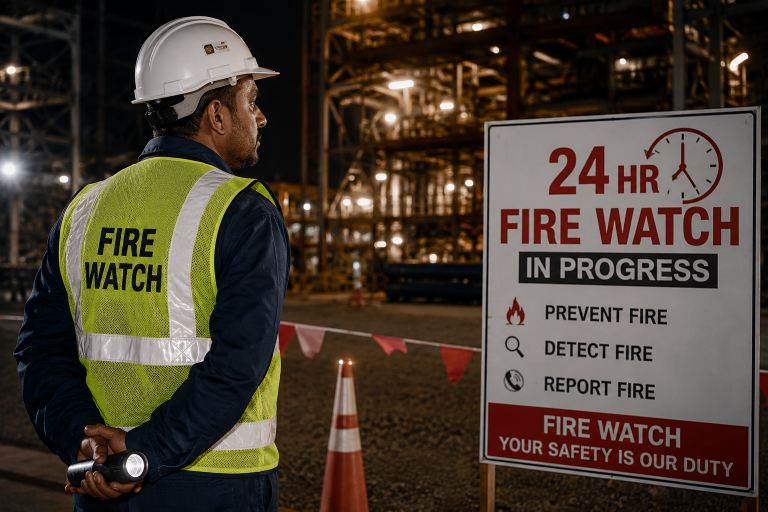

A fire alarm panel goes offline. A sprinkler system needs repair. Or a suppression system must be shut down for planned maintenance. Whatever the cause, a building has less protection while that system is impaired. The response should begin immediately, not after a problem develops.
For occupied properties, 24/7 fire watch coverage may be needed when an approved fire watch is required to protect people left without normal fire protection. The exact response depends on the system affected, occupancy, duration, applicable fire code, and direction from the authority having jurisdiction (AHJ).
Step 1: Identify What Has Failed
Start by defining the impairment. A fire alarm outage creates a different risk from a sprinkler shutdown, while a standpipe or suppression-system impairment may affect another part of the building’s protection plan.
Determine:
- Which system is out of service
- Which areas are affected
- Whether the outage is planned or unexpected
- How long the impairment may last
- Whether the building remains occupied
This information helps the impairment coordinator and responsible personnel decide what temporary measures are needed.
Step 2: Notify the Right People
Notification should happen promptly. Depending on the applicable requirements, this may include the fire department, fire code official, building management, alarm-monitoring provider, fire-protection contractor, insurer, or other responsible parties.
The International Fire Code framework requires notification when a required fire-protection system is out of service. It also provides for evacuation or an approved fire watch when required by the fire code official.
Do not assume that one notification procedure applies to every property. Follow the site’s impairment plan and the instructions of the AHJ.
Step 3: Decide Whether a Fire Watch Is Required
This is the key decision point. A system outage does not automatically mean the same response is required for every building.
Consider:
- Is the building occupied?
- What protection has been lost?
- How large is the affected area?
- How long will the impairment continue?
- Has the AHJ required a fire watch?
- Is evacuation required or practical?
- Does the property have an approved impairment-management program?
Where a required fire-protection system is out of service, code provisions may require an approved fire watch for occupants left unprotected by the shutdown. The watch is intended to provide continuous patrol and fire detection until the system returns to service.
Step 4: Post and Brief the Fire Watch
Posting a guard is only part of the process. The person assigned to the watch needs clear instructions before beginning patrols.
The briefing should cover:
- The impaired system
- Areas requiring patrol
- Emergency communication methods
- Alarm and evacuation procedures
- Fire-extinguisher locations
- Reporting requirements
- Who to contact when conditions change
For system impairments, the fire watch’s role is focused on detecting fire and protecting the affected premises. Certain fire-code provisions specifically state that fire-watch personnel should have an approved means of notifying the fire department and no duties beyond constant patrol and fire watch.
Step 5: Document Every Patrol
Good documentation creates a record of what happened while protection was impaired. Depending on site and jurisdictional requirements, records may include patrol times, areas inspected, hazards discovered, incidents, notifications, corrective actions, and the start and end of coverage.
The goal is not paperwork for its own sake. A clear log helps management demonstrate that the impairment was actively monitored and that issues were addressed as they arose.
Step 6: Know When the Fire Watch Can End
The repair crew finishing the work does not necessarily mean the fire watch can immediately leave.
Before ending coverage, confirm that:
- The affected system has been repaired.
- Required testing or inspection is complete.
- The system has been returned to service.
- Required notifications have been made.
- The AHJ’s conditions have been satisfied.
- Final documentation is complete.
The applicable impairment procedure should determine when normal fire protection has been restored.
Planned Outage vs. Emergency Failure
Planned outages provide an opportunity to prepare before protection is reduced. Arrange required notifications, coordinate contractors, establish temporary measures, and schedule 24/7 fire watch coverage before the shutdown when continuous monitoring is required.
An unexpected failure requires faster action. Identify the impairment, notify the appropriate parties, assess the affected risk, and implement the required temporary protection without waiting for the situation to resolve itself.
The Fire-System Outage Checklist
Before considering the response complete, verify that you have:
- Identified the failed system and affected area
- Estimated the outage duration
- Made required notifications
- Contacted the AHJ when applicable
- Determined whether evacuation or fire watch is required
- Briefed the assigned fire-watch personnel
- Established patrol areas and communication procedures
- Maintained required records
- Monitored repair progress
- Verified system restoration
- Completed the impairment closeout
One final distinction matters: fire-watch rules for a fire-protection-system outage are not the same as OSHA requirements for a hot-work fire watch. For example, the OSHA standard for welding and cutting demands a fire watch on certain combustible material conditions and 30 minutes of observation following welding or cutting activities.
The safest course to follow is to always manage all fire-system failures as an impairment issue. Determine what has been lost, abide by the code and AHJ guidance, implement approved temporary protective measures, and record the resolution before terminating the fire watch.